What Happens To Your Bitcoin When You Die?
Without a plan, your heirs may never access a single Satoshi - no matter how much you own. Don’t leave your Bitcoin to chance. Schedule a FutureProof Planning Session to build a secure Bitcoin inheritance plan that actually works.

Bitcoin is unlike any asset you’ve ever owned. No bank holds it for you. No government can print more. And when you die, there is no password recovery, no customer service line, and no probate court order than can unlock it - unless you planned ahead.
For digital asset holders thinking about estate planning, the first questions that need to be asked are: (i) where is your Bitcoin? and (ii) who could access it tomorrow if something happened to you?
The answers depend entirely on how you hold your BTC: on a hot wallet (a custodial exchange like Coinbase or Robinhood) or in cold storage (a hardware wallet like Trezor, Coldcard, Bitkey, or Tangem). Each carries very different risks - and requires a very different estate planning strategy.
The Core Problem: Bitcoin Has No Beneficiary Field
When you open a brokerage account or IRA, you fill out a beneficiary designation form. When you die, the institution handles the transfer. It’s a simple, tested, and legally recognized.
Bitcoin works nothing like this. There is no institution. No form. There is only a private key - a cryptographic secret that controls access to funds on a private ledger. Whoever holds the private key (or the seed phrase that generates it controls the Bitcoin. Full stop.
Critical Reality: It is estimated that ~20% of all Bitcoin in circulation -roughly 3-4 million BTC - is already permanent lost, much of it due to holders dying without access instructions. At current prices, that represents hundreds of billions of dollars that will never move again.
This is not strictly a legal problem. It is a technical and planning problem. Your will could say “I leave my Bitcoin to my children,” but if they don’t have the private key or seed phase, those words are worthless. And to make matters worse, a probate judge cannot compel the Bitcoin network to transfer funds. There is no Bitcoin Inc. to call.
The solution is not simpler than you’d like - but it is entirely achievable with the right legal structure and a bit of technical preparation.
Hot Wallets: Coinbase, Kraken, Gemini, Cash App, Robinhood, & Other Custodial Exchanges
A hot wallet is any Bitcoin storage connected to the internet and managed by a third-party company. When you buy Bitcoin on Coinbase, Kraken, Gemini, Cash App, or Robinhood, you don’t actually hold Bitcoin in the traditional sense - you hold a claim on Bitcoin that the exchange holds on your behalf.
The famous phrase in the crypto community is: “Not your keys, not your coins.” Nowhere is this more true than on a hot wallet since the exchange holds the private keys. You only hold the username and password.
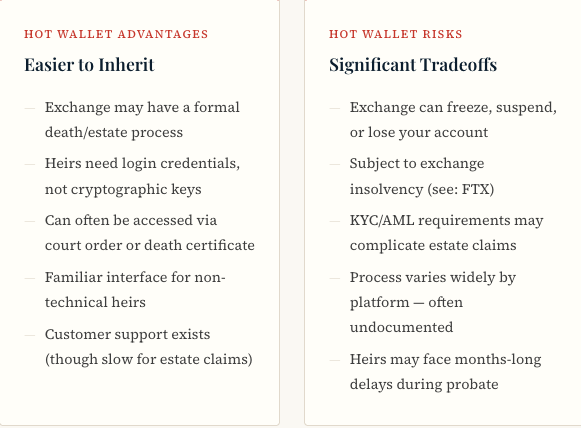
What the Inheritance Processes Actually Looks Like on a Hot Wallet or Custodial Exchange
Custodial exchanges like Coinbase have documented estate resolution processes. Heirs typically need to submit a death certificate, proof of identity, and legal documentation (such as letters testamentary from a probate court or a trust certification). The process can take 8-16 weeks or more, and Coinbase reserves the right to request additional documentation at any stage. Other custodial exchanges like Robinhood and Cash app treat holdings similarly to stock positions, meaning their inheritance process mirror their processes for stock estate transfer.
Importantly, however, the Bitcoin remains on the custodial platform during the transfer process - meaning it’s still subject to the applicable terms of service, any regulatory freezes, and the exchange’s ongoing solvency (or insolvency). Furthermore, despite the verifiable presence of Bitcoin on the exchange, there is no guarantee your heirs will receive self-custodied Bitcoin via transfer to a Bitcoin wallet, as the process may require receipt of U.S. dollars via transfer to an external account or even the sale of the Bitcoin held on the exchange. Given the potential future valuation of Bitcoin, this could mean the loss of thousands or even millions of dollars in purchasing power due to an estate planning error.
Cold Storage: Trezor, Coldcard, Bitkey, Tangem, etc.
Cold storage means holding Bitcoin in a hardware wallet - a physical device that stores your private keys offline, never exposing them to the internet. This is the gold standard for Bitcoin security, particularly among the “OG’s.” It is also the most legally and practically complex to pass on after death.
With cold storage, you are your own bank. There is no intermediary, no customer support, and no account recovery. Your heirs need one thing and one thing only: your seed phrase - typically 12 or 24 words that can regenerate your private keys on any compatible device. However, the nature of the device and method of storage differ depending on the type of cold storage device you use. For example:
Trezor is one of the oldest and most trusted hardware wallet brands. It uses a standard BIP-39 seed phrase backup (12 or 24 words). For inheritance purposes, this means your heirs need the physical device and/or the seed phrase written on paper (or better yet, stamped into metal). Trezor also supports passphrase protection - an additional password layered on the seed phrase. If you use a passphrase, your heirs need both the seed words and the passphrase, or the wallet appears empty. This information can and should be stored in a digital asset emergency guide or memorandum that is accessible to heirs - or, even better, a technical fiduciary with competence to access and recover funds.
Coldcard is an air-happed hardware wallet favored by advanced Bitcoin holders. It never connects directly to a computer via USB in a live session, instead signing transactions on a MicroSD card. It supports a broad range of security features including brick-me PINs and duress wallets. For inheritance, this complexity cuts both ways: the device is extraordinarily secure in life, yet technically sophisticated for heirs (or attorney guided fiduciaries) to recover funds. As a general practice, therefore, a Coldcard user must have a written recovery guide in their estate documents.
Bitkey takes a notably different approach by virtue of the fact that the device was designed with inheritance and recovery in mind. Bitkey uses a 2-of-3 multisignature scheme: one key on the hardware device, one key on your phone, and one key held by Block (the company who produces the device). Any two of three keys can authorize a transaction. Thus, if the hardware device is lost, Block’s key and your phone key can recover funds. If Block becomes insolvent, your device and your phone key can recover funds. If you lose your phone, Block’s key and the device can recover funds. For heirs, this means that recovery does not depend entirely on a physical seed phrase - though estate planning documentation is still essential to authorize Block to assist with inheritance.
Tangem uses NFC-enabled cards (that fit in your wallet) instead of a traditional hardware device. It ships with two or three cards - allowing the backups to serve as recovery. Tangem does not generate or display a seed phrase by design (because it is forgettable if not written down). Instead, the key lives electronically on the card chips. This means that inheritance simply requires possession of the physical cards or backup cards (in addition to a PIN). Losing all cards means losing the Bitcoin, so for estate planning purposes, the backup cards must be treated like physical gold or other valuables requiring security and protection.
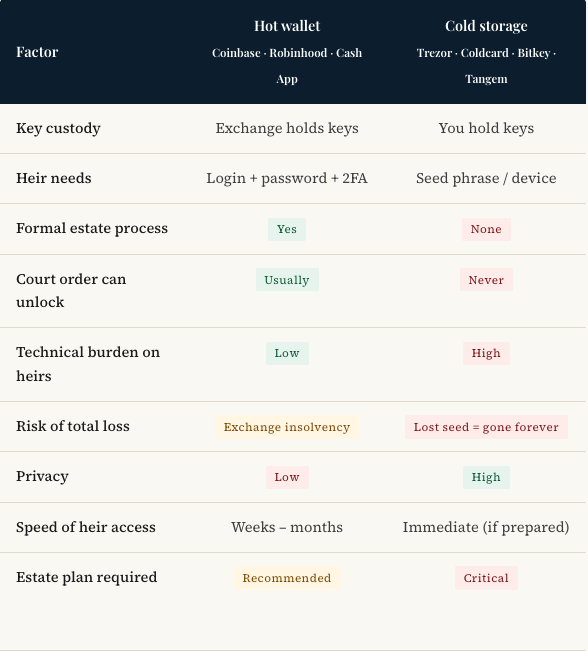
For high net worth individuals or individuals concerned about security, multi-sig access is currently the most inheritance-friendly cold storage design because it doesn’t require heirs to locate and correctly use a seed phrase - one of the most common points of failure in crypto estate claims. That said, introducing institutional points of failure to sovereign wealth presents problems of its own, and all cold storage systems require a comprehensive estate plan to be truly secure for heirs.
The Seed Phrase Problem and the Most Dangerous Information in Your Estate Plan
Your seed phrase is simultaneously the most powerful and the most dangerous thing in your estate. Stored wrong, it could get stolen. If not stored at all, your heirs may get nothing.
For cold storage holders, the seed phrase must be:
Kept secret - anyone with your seed phrase has full, immediate access to your Bitcoin. No authentication required. There is no “undo” it if falls into the wrong hands.
Kept accessible - at least one person you trust (ideally a technically-competent fiduciary), or a legally structured mechanism, must be able to locate and use it after your death.
Kept durable - a paper seed phrase can be destroyed by fire, flood, or aging. Metal seed phrase backup products like Cryptosteel, Bilodreauz, or Blockplate exist precisely to address this.
This creates an obvious tension: the more people who know where your seed phrase is, the less secure your Bitcoin is during your lifetime. The fewer people who know, the higher the risk your heirs can’t access it after your death.
Common (Dangerous) Approaches to Avoid
To securely transfer Bitcoin to your heirs, the following approaches to seed phrase storage must be avoided at all costs:
Storing the seed phrase in a password manager or other online platform that could be the subject of hacking
Photographing the seed phrase when your photos sync to Cloud or other electronically systems that could be compromised
Storing it in your wills, which could become part of a public record in probate
Telling one family member verbally and assuming they will remember
Splitting the seed phrase and giving half to two people without a documented reunification plan
How to Actually Plan for Bitcoin Inheritance
A proper Bitcoin estate plan layers legal documents with technical access instructions and a secure handoff mechanism. Here is what that looks like in practice.
Step 1: Inventory Your Holdings
Create a private, secure document listing every location where you hold Bitcoin: exchanges by name, cold storage devices, wallet addresses, and approximate balances. This is your digital asset inventory. Do not include seed phrases or passwords here - that needs to be in a separate, more restricted document.
Step 2: Choose a Secure Credential Storage Method
Once you decide on your preferred method of holding (hot or cold wallet), your storage options range from a fireproof safe to a bank safety deposit box to a multi-sig institutional solution or even an attorney-held sealed envelope. Each has tradeoffs. However, many clients use a combination of these options. The key is that at least one trustworthy person knows how to access each layer.
Step 3: Use a Trust, Not a Will
A revocable living trust can hold Bitcoin-related access instructions without those instructions becoming part of the public probate record. Trust documents remain private. A digital estate planning lawyer can also structure an estate plan that names a technical or digital asset trustee and provides the trustee with legally-binding instructions for accessing and distributing crypto assets - without exposing your seed phrase publicly.
Step 4: Consider a Digital Asset POA
A durable power of attorney with explicit digital asset language gives a trusted agent the legal authority to manage your Bitcoin if you become incapacitated - not just after death. Without this, even a family member with your seed phrase could face legal ambiguity about their right to act on your behalf while you are alive.
Step 5: Write a Letter of Instruction for Your Heirs
A Letter of Instruction is a non-legal document that walks your heirs through, step by step, how to access your Bitcoin. It should explain what exchanges you use, what hardware wallets you own, how to use them, what professional resources to contact, and what NOT to do (e.g., don’t tell anyone online, don’t rush to sell, verify the address before any transaction, etc.). This document should also be held separately from your seed phrase.
Final Thoughts
Millions of dollars in Bitcoin are lost every year not to hackers or market crashes, but to death. For that reason, digital inheritance planning remains one of the largest unaddressed issues in the entire crypto industry.
FutureProof Law, L.L.C. was created to address this deficiency and provides digitally-native estate planning services to a generation of investors that hold wealth differently. With proper planning techniques, the reality is that millions of dollars of sovereign wealth can be saved and put to good use by heirs for many generations.
Frequently Asked Questions
***
What Happens to Bitcoin on a Custodial Exchange Like Coinbase When the Account Owner Dies?
These exchanges usually have an estate resolution process that mirrors the process for inheriting stock. Heirs must submit a death certificate, proof of identity, and legal documentation proving their right to the funds. The process usually takes several months and the funds remain subject to the exchange’s terms and conditions until a transfer is made. Institutional risk of insolvency also remains.
Can My Heirs Recover My Bitcoin if I Die Without Leaving My Seed Phrase?
If your Bitcoin is in cold storage and your heirs do not have your seed phrase, the Bitcoin is almost certainly inaccessible. There are professional services that attempt to recover access in some circumstances (e.g., if you remember partial information or if the hardware device is intact), but there are last resorts with low success rates. There is no legal mechanism to force the Bitcoin network to transfer funds without the private key.
Should I Put My Bitcoin Seed Phrase in My Will?
Absolutely not. Wills become part of the public probate record in most jurisdictions. Your seed phrase would therefore become publicly accessible and be vulnerable to theft. Seed phrase instructions should be held in a private document that remains out of the public realm in a secure location.
Is Bitcoin in a Hot Wallet Protected Like a Bank Account?
No. Crypto held on exchanges is not FDIC insured, and, while some exchanges carry insurance, coverage limits and terms vary. The collapse of FTX demonstrated that even large, reputable-seeming exchanges can become insolvent, with customer claims taking years to resolve in bankruptcy proceedings and payouts sometimes yielding pennies on the dollars and reduced values of Bitcoin-equivalent funds.
What is a Digital Asset Trustee of Technical Fiduciary and Do I Need One?
A digital asset trustee or technical fiduciary is someone you designate to manage your cryptocurrency in the event of your death or incapacity. They should be technically capable of using hardware wallets and crypto platforms, and legally empowered in your trust documents and POA to act on your behalf. This role can be filled by a trusted individual or by a professional digital asset trustee service. Whether you need one depends on the complexity of your holdings and the technical sophistication of your heirs.
FutureProof Law, L.L.C. is a private wealth and estate planning virtual law firm focused on helping affluent Millennials, Bitcoiners, and forward-thinking families protect their privacy, portability, and sovereignty in the digital age. Founded in 2026 by Attorney Jake Bruner, FutureProof Law, L.L.C. prioritizes an underserved generation of worried clients building wealth and legacies in a modern world. Through the preparation of creative and compassionate, digitally-native estate plans, FutureProof Law, L.L.C. helps the next generation of clients in Colorado, Florida, Ohio, and Pennsylvania seize control of their lives and legacies on the cusp of the largest transfer of wealth in history. To begin planning your future, book your FutureProof Planning Session today or contact Jake Bruner directly by phone (303-962-0625) or email (jake@futureproof.law).